

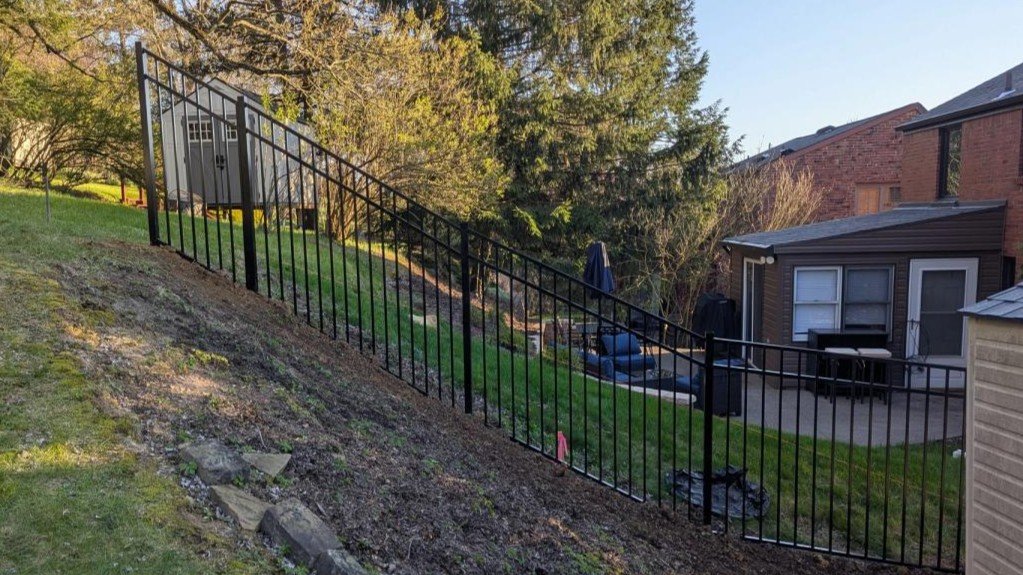
You may have recently bought a home in Greater Pittsburgh, or perhaps you have lived here for years and are now considering a fence for more privacy, added security, or to help keep children and pets safely in the yard.
But if your property slopes, rises sharply, or changes elevation along the fence line, you may be wondering whether a fence will even work. Will it follow the ground properly? Will it look uneven? Could noticeable gaps be left underneath?
These are common concerns in a region known for hilly and uneven properties. The good news is that a sloped yard does not necessarily prevent you from installing a fence. There is no single fence material that is best for every slope. Rackable aluminum and chain link can follow many changes in grade, while wood and vinyl can often be stepped or otherwise adapted to the terrain.
The right choice depends on how steep the yard is, how much privacy or containment you need, and how the fence system can be installed along the grade.
Can You Install a Fence on a Sloped or Uneven Yard?
Yes. Fencing can usually be installed on a sloped or uneven property, but the layout needs to reflect both the terrain and the purpose of the fence.
A gentle, consistent slope may require a different installation approach than a yard that drops sharply near a retaining wall. The proposed fence line might also cross a low spot or drainage area, or run alongside steps, landscaping, or another feature that affects where posts and gates can be placed.
How you plan to use the fence matters as well. A small gap underneath may not be a major concern for a decorative fence, but it can create a problem if the fence is intended to contain a small dog. A privacy fence must also account for neighboring homes or decks at higher elevations, while a gate needs enough clearance to open without scraping the ground.
Evaluating these needs together helps determine which materials and layouts are realistic for the property.
Is It Better to Rack or Step a Fence on a Slope?
Fences on slopes are commonly installed using a racked or stepped layout.
A racked fence follows the angle of the ground. The fence section adjusts with the slope so the bottom remains relatively close to the grade. This can create a smooth line across a gradual hill and help reduce gaps beneath the panels.
But not every panel can adjust by the same amount. Racking capacity depends on the product, panel design, and severity of the slope. A system that follows a gentle hill may not be able to accommodate a much steeper grade.
A stepped fence uses level sections that move down the property like stairs. Each section remains horizontal, while the posts are installed at different elevations.
Stepping may work better when the grade changes sharply, or the selected panels are designed to remain level. The main tradeoff is that triangular gaps can appear beneath the downhill ends of the panels.
Neither approach is right for every yard. The best choice depends on the slope, fence system, desired appearance, and how the enclosed space will be used.
Which Fence Materials Work Well on Slopes?
Wood, vinyl, aluminum, and chain-link fencing can all work on uneven ground, but the material alone does not determine whether a particular fence will suit the slope. At Fence & Railing Unlimited, LLC, we look at the grade, intended use, preferred appearance, and available fence styles before recommending an option for the property.
Wood Fencing
Custom-built wood fencing offers considerable flexibility. Boards and rails can often be stepped down a hill or configured to follow portions of the grade more closely.
Wood can provide full privacy, partial screening, or a more open design. The tradeoff is ongoing maintenance. Low or damp areas deserve particular attention because prolonged moisture exposure can contribute to deterioration.
Vinyl Fencing
Vinyl appeals to homeowners who want privacy, a consistent appearance, and relatively low routine maintenance.
Some vinyl fence systems are designed to accommodate a gradual grade, while others need to be stepped. Because the panels are manufactured in specific configurations, it is important to choose a vinyl fence system that can accommodate the grade of the yard.
This is especially important with solid privacy panels, where changes along the top and bottom of the fence will be easy to see.
Aluminum Fencing
Many aluminum fence systems are available in rackable designs that can follow gradual or moderate slopes.
Aluminum may be a good fit when you want an open, finished appearance without blocking the view. If the fence will contain children or pets, however, the picket spacing and room beneath the panels must be appropriate for that purpose.
Chain-Link Fencing
Chain link is often chosen when containment, security, or coverage of a larger area is the priority.
Its woven fabric can generally accommodate changes in grade more readily than rigid panels. Low spots and dips can still leave openings beneath the fence, particularly where the yard borders woods or the fence is intended to contain a dog.
So, What Fence Is Best for Your Sloped Yard?
The best option depends less on the fact that your yard slopes and more on what you need the fence to accomplish.
If keeping the bottom of the fence close to the ground is important, a rackable system or another design that follows the grade may be preferable where the slope allows it. If privacy is the priority, wood or vinyl may offer more screening, but the grade will affect whether the fence can follow the hill or needs to be stepped.
Aluminum can work well when you want an open appearance and a system designed to rack with the slope, while chain link can be practical for containment or larger fence lines where appearance is not the only priority.
On a steep or irregular Pittsburgh property, the best solution may even use different installation approaches along different portions of the same fence line.
How Can a Slope Affect Gaps, Privacy, and Gates?
The grade can affect more than how the finished fence looks.
A stepped layout is more likely to create triangular gaps beneath the downhill side of each section. A racked fence may stay closer to the ground, but low spots, erosion, or sudden grade changes can still leave openings.
These gaps are especially important for pet owners. A smaller dog may be able to slip underneath, while loose soil can give a larger dog a place to begin digging. At the same time, placing every part of the fence tightly against the soil may not be appropriate in areas where water collects.
Privacy also depends on elevation, not just fence height. If a neighboring deck, window, or yard sits higher than yours, people may still be able to see over a fence that provides adequate screening elsewhere.
It helps to identify the area where privacy matters most, such as a patio, pool, or seating area. The fence design and placement can then be planned around those sight lines rather than treating every part of the yard the same way.
The slope can also complicate gate placement. The gate needs enough clearance to swing open without scraping the ground, but too much space beneath it can leave a noticeable gap.
When possible, placing the gate on a flatter section of the yard can make it easier to operate. The width should also reflect whether the gate will be used by people, a mower, a trailer, or a vehicle.
What Should You Check Before Installing a Fence on a Slope?
Before the layout is finalized, confirm the property lines and check the local requirements that apply to the property. Depending on the location and project, that can include municipal zoning or permit requirements, homeowners association rules, easements, and pool-fencing standards.
Requirements can differ between the City of Pittsburgh and surrounding boroughs and townships.
Before digging begins, the person performing the excavation should submit the required locate request through Pennsylvania 811. If a homeowner is doing the work, the homeowner makes the request. If a contractor is performing the excavation, the contractor is responsible for making it. Pennsylvania 811 then notifies participating underground facility owners so they can respond to the request and, when necessary, mark affected underground lines.
An on-site evaluation gives the contractor an opportunity to walk the proposed fence line and examine:
- Changes in elevation
- Retaining walls and steps
- Low or wet areas
- Drainage and erosion concerns
- Possible gate locations
- Areas where gaps could become a problem
Greater Pittsburgh’s hilly terrain, precipitation, winter weather, and freeze-thaw cycles can affect soil and drainage conditions along a proposed fence line. Looking at those conditions before the layout is finalized can help determine where posts, panels, and gates can be placed most effectively.
Find the Right Fence for Your Sloped Pittsburgh Yard
A sloped yard does not rule out wood, vinyl, aluminum, chain link, or other fencing options. The key is choosing a fence system and installation approach that work with the grade, intended use, desired appearance, gate access, maintenance preferences, and budget.
On one property, that may mean rackable aluminum that follows the grade. On another, stepped vinyl, custom-built wood, or chain link may make more sense. Irregular yards may even require different approaches along separate portions of the fence line.
At Fence & Railing Unlimited, LLC, we help Greater Pittsburgh homeowners compare fencing options based on the layout of their property and how they plan to use the space. With more than 20 years of hands-on experience, owner David Porter is personally involved in the estimating process and helps homeowners identify a practical approach based on their property, priorities, and budget.
We install wood, vinyl, aluminum, chain-link, and split-rail fencing, along with custom gates, throughout Allegheny, Beaver, Butler, Washington, Fayette, Westmoreland, and Lawrence counties.
If you are considering a fence for a sloped or uneven property, contact our team to request a free on-site estimate and discuss what may work for your yard.
Disclaimer: This article is for general informational purposes only. Fence requirements, permitting rules, installation methods, and site conditions vary by property and municipality. A professional on-site evaluation is recommended before planning or installing a fence.